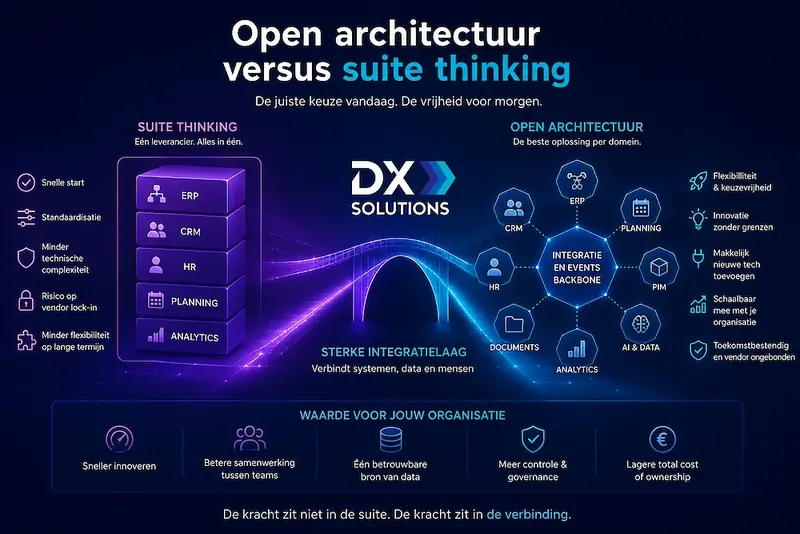
Open architecture versus suite thinking
Discover the pros and cons of best-of-breed, one suite, and hybrid architectures. Which approach offers the most flexibility for the future?
Tuesday 16 June 2026 · Xavier D.
In our previous blogs, we discussed middleware, vendor lock-in, and the importance of a strong integration layer for successful AI initiatives.
This naturally brings us to a strategic question that many organizations are confronted with sooner or later:
Do we opt for a single supplier that offers everything, or do we build a landscape with the best solution per domain?
It is a discussion that has been going on for years.
Yet today it becomes more relevant than ever.
After all, AI, cloud platforms, specialized software, and modern integration platforms make the choice more complex than before.
The appeal of a single suite
Virtually every major software vendor has a clear story today.
Microsoft. JUICE. Salesforce. Oracle. ServiceNow. HubSpot.
The message is often the same:
Why combine different systems when one ecosystem can offer everything?
That story naturally has strong arguments.
A suite often offers:
One supplier One contracting party One user experience Standard integrations Less technical complexity Faster initial implementations For many organizations, that is a logical choice.
Especially when speed, standardization, and manageability are important.
The other side of the story
The challenge usually does not arise during implementation.
It emerges a few years later.
When new needs arise.
When a department needs a specialized solution.
When an acquisition takes place.
When AI creates new possibilities.
Or when it turns out that one part of the suite is no longer the best choice.
Suddenly, a dilemma arises.
Are you replacing the entire ecosystem?
Or will you add a specialized solution after all?
That is often precisely where the tension between standardization and flexibility begins.
Best-of-breed sounds simpler than it is
At the other end of the spectrum, we find the so-called best-of-breed model.
There, an organization consciously selects the solution per domain that best aligns with its needs.
For example:
A specialized ERP A separate CRM solution A dedicated planning tool A specialized PIM system A separate data platform A specific AI solution The advantage is clear.
Each department receives the solution that best aligns with its processes.
But a new challenge arises.
All those systems must communicate with each other.
And that is precisely where architecture and integration become crucial.
Why this is different today than ten years ago
In the past, best-of-breed often meant a major technical challenge.
Integrations were expensive.
APIs were limited.
Real-time synchronization was complex.
As a result, many companies consciously opted for a single suite.
Today, the world looks different.
API-first software is increasingly becoming the norm.
iPaaS platforms make integrations more accessible.
Event-driven architectures are gaining ground.
AI agents can combine different systems.
As a result, a hybrid approach is becoming increasingly feasible.
Most companies ultimately opt for a hybrid model.
In practice, we rarely see organizations that opt entirely for one of the two extremes.
Most modern IT landscapes are evolving towards a combination of both.
A number of core systems remain central.
Surrounding this, specialized applications emerge that solve specific business needs.
That often yields the best of both worlds:
Stability where necessary Flexibility where possible Innovation without complete migrations Freedom to add new technologies But only when the underlying architecture is sufficiently strong.
AI makes this choice even more important
The rise of AI is changing the discussion again.
After all, AI agents pay little attention to the application boundaries that companies have historically built up.
They want access to data.
To processes.
To context.
Goodbye.
Whether that information comes from a single suite or from ten different systems is often less relevant to an AI agent.
However, the systems must be connected.
As a result, the focus is shifting increasingly from software selection to architecture selection.
Not:
Which application do we choose?
But:
How do we ensure that future technologies gain easy access to our business knowledge?
There is no universally correct choice
The reality is simple.
There is no perfect architecture.
A fully suite-based approach can work perfectly.
A best-of-breed strategy can be just as successful.
The right choice depends on:
The maturity of the organization Available IT capacity Growth plans Innovation ambitions Compliance requirements Budgets Existing investments The fault usually does not lie in the technology.
The fault often lies in the lack of a clear architectural vision.
The real question
When organizations evaluate software today, conversations often focus on functionality.
Can the system do this?
Can the system do that?
Which features are missing?
Those are important questions.
But perhaps there is a more important question.
Which software are we choosing today?
How much freedom do we retain to make new choices tomorrow?
For in a world where technology is evolving ever faster, flexibility is increasingly becoming a competitive advantage.
And that is precisely why this discussion is ultimately much less about software than about strategy.
Watch the video: our approach in two minutes
Modern businesses need a flexible and scalable IT landscape. Discover how DXS supports this.
Discover our AI agents Previous blog:
VLAIO supports the development of FieldGenius Next blog: