Why AI without a strong integration layer often fails
Many AI projects fail not because of AI, but because of poor integrations. Discover why data, semantics, and architecture are crucial.
Monday 1 June 2026 · Xavier D.
In our previous blogs, we reflected on the increasing complexity of modern IT landscapes, the strategic role of middleware, and the impact of vendor lock-in.
In this fourth blog, we look at a topic that currently comes up in almost every board meeting: artificial intelligence.
Expectations are high.
AI would automate processes, make employees more productive, support better decision-making, and even enable new business models.
However, in practice, we see that many AI initiatives never get beyond a proof of concept, an isolated chatbot, or a one-off experiment.
Not because AI technology falls short.
But because the underlying integration layer is missing.
AI is only as smart as the information it receives.
Many organizations focus on the AI tool itself today.
Which LLM do we choose? Which copilot do we use? Which agent do we build?
Those are relevant questions.
But they often come too early.
Because AI does not derive its value from the model itself. AI derives its value from the quality, availability, and context of the information with which it can work.
When data is scattered across various systems such as ERP, CRM, documents, emails, SharePoint, spreadsheets, and external data sources, a fundamental problem arises.
The knowledge exists, but AI cannot access it efficiently.
An AI model that has access to only a small part of the business knowledge will also be able to realize only a limited part of the potential value.
The biggest challenge is rarely AI.
When companies start with AI, many expect the challenge to lie in machine learning, prompting, or model choices.
In reality, the biggest challenge often turns out to be much less sexy.
Integrations Data.
Access rights.
Data quality.
Semantics.
Business context.
In other words: the foundations that have been important within IT for years.
AI simply exposes these weaknesses much faster.
An organization with fragmented data will not get intelligent AI.
She gets an intelligent version of the same fragmentation.
Why many AI projects get stuck
Many AI projects follow the same pattern.
A team builds a first chatbot.
The results are promising.
Next comes the question:
Can he also access customer data?
Then:
Can he look up quotes?
A little later:
Can he combine data from the ERP with information from SharePoint?
Suddenly, it turns out that the real challenge is not the AI, but the connection between all systems.
Many organizations encounter the same limitations there:
Data silos Missing APIs Outdated connections Inconsistent data Limited governance Vendor lock-in The consequence is that AI delivers much less value than originally expected.
AI agents make this even more important
Meanwhile, the next evolution is already presenting itself.
AI is shifting from simple copilots to AI agents that perform tasks independently.
An officer answering a question is interesting.
An agent who gathers information, analyzes it, prepares decisions, and executes actions only becomes truly valuable.
But for that, he needs access to multiple systems.
An AI agent that is not connected to CRM, ERP, planning, documents, and operational data ultimately remains limited to general answers.
And that is precisely where a strong integration layer becomes crucial.
Middleware and integrations are becoming more strategic than ever
In classical architecture, middleware was often viewed as a technical component.
Something that connects systems.
Within an AI-driven organization, that perspective changes.
Suddenly, the integration layer determines:
Which data is available Which processes can be automated Which AI agents are possible How quickly new innovations can be rolled out The integration layer is thereby evolving from supporting technology to a strategic enabler.
Not because middleware is becoming more important than AI.
But because AI can create much less value without that foundation.
Is intelligence shifting away from middleware?
Reading this blog might give the impression that middleware is once again becoming the center of the universe.
In our view, that is not necessarily the direction in which the market is evolving.
Whereas middleware was formerly often responsible for both transport and business logic, today we increasingly see a layered architecture emerging in which those responsibilities are separated.
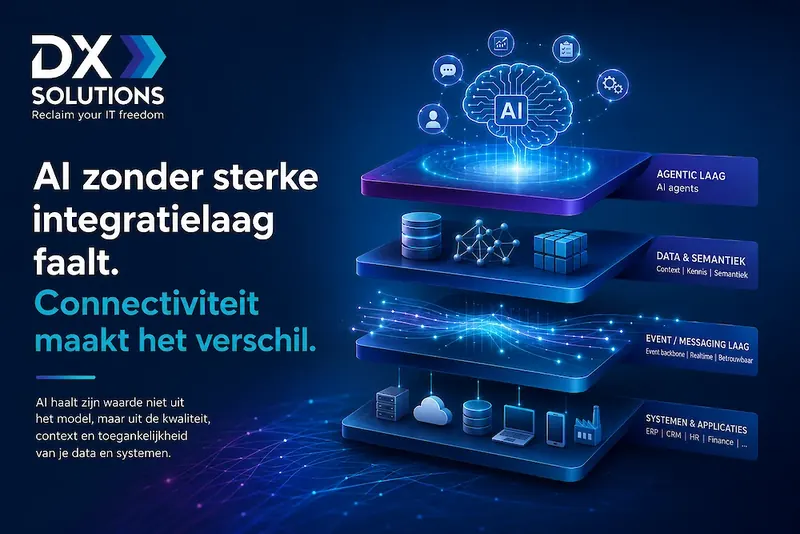
More and more organizations are building around four distinct layers:
Systems and applications Eventing, messaging and integration Data and semantic layers AI agents and intelligent applications In that architecture, middleware is shifting increasingly towards a reliable event backbone.
The focus is on connectivity, scalability, reliability, and real-time data streams.
Intelligence is increasingly moving to higher levels.
Semantic models, context, knowledge graphs, data warehouses, lakehouses, and AI play an increasingly important role there.
Concepts such as the medallion architecture ensure that information is not only available but also acquires meaning. AI agents can then operate on that semantic layer and make decisions based on context rather than predefined processes.
However, that does not mean that middleware is becoming less important.
On the contrary.
The smarter the overlying layers become, the more important a stable, reliable, and real-time integration layer becomes.
The challenge therefore shifts from "which technology do we choose?"
to "how do we make all these layers work together optimally?"
And that, in our view, is precisely where one of the most important architectural questions of the coming years lies.
What about citizen development?
We see a similar evolution within low-code and citizen development.
Platforms such as n8n, Power Platform, Zapier, and other automation solutions are bringing more and more possibilities to business users.
What was only possible within classic enterprise middleware a few years ago can often be realized much faster today via modern automation platforms.
However, that does not mean that enterprise integration is disappearing.
The more automation occurs at the top end, the more important the underlying layers surrounding data, semantics, governance, eventing, and integration become.
The future therefore probably does not lie in a single all-encompassing platform.
However, in architectures where different layers collaborate and reinforce each other.
The future is connected
The companies that will benefit most from AI in the coming years are not necessarily those with the most advanced models.
It will often be the organizations that possess:
Qualitative data Strong integrations Open architectures Clear semantics Scalable processes Because AI is becoming less and less of a standalone technology.
It will become a layer on top of the existing business landscape.
And the better that landscape is connected, the greater the value that AI can deliver.
AI is not an island
When organizations think about AI today, conversations often start with tools, models, and use cases.
Perhaps they should start with a different question more often:
How well are our systems actually connected today?
Because AI without a strong integration layer is a bit like a Formula 1 car without fuel.
Impressive to look at.
Hardly suitable for getting anywhere.
Watch the video: our approach in two minutes
Modern businesses need a flexible and scalable IT landscape. Discover how DXS supports this.
Discover our AI agents Previous blog:
Open architecture versus suite thinking Next blog: