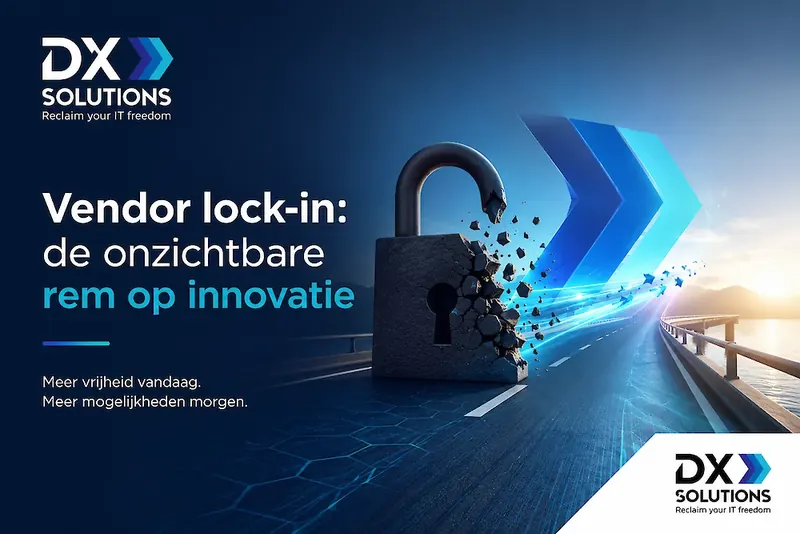
Vendor lock-in: the invisible brake on innovation
Vendor lock-in often limits innovation more than companies realize. Discover how open architectures offer more flexibility and freedom of choice.
Monday 1 June 2026 · Xavier D.
In our previous blogs, we reflected on the increasing complexity of modern IT landscapes and the strategic role that middleware plays in this.
In this third blog in our series, we delve deeper into a topic that often only receives attention when it is too late: vendor lock-in.
However, vendor lock-in has a direct impact on:
innovation capacity flexibility future AI capabilities speed of change total cost of ownership of an IT landscape
Virtually every software vendor promises flexibility today.
Open APIs, cloud-native architectures, AI integrations, extensible platforms, and extensive ecosystems must convince companies that they are ready for the future.
However, after a few years, many organizations find that change has become more difficult rather than easier.
New integrations prove to be complex Data is spread across various platforms Migrations are becoming expensive Innovations require unexpectedly much effort And often the cause lies not with the software itself, but with something much less visible:
vendor lock-in .
Vendor lock-in is not new
Vendor lock-in has existed for as long as software has existed.
In the past, we saw this primarily with ERP systems. Companies invested for years in customization, processes, and integrations around a single platform. Over time, change became so expensive that, in practice, the organization no longer had a real choice.
Today, we see the same phenomenon emerging within cloud platforms, AI solutions, automation platforms, data systems, and complete SaaS ecosystems.
The difference is that lock-in has become more subtle.
Not because data cannot be exported. Not because connections are impossible. But because business processes, automation, knowledge, and dependencies are becoming increasingly deeply embedded in one specific ecosystem.
This creates a situation where a company might still be able to change technically, but hardly dares to operationally.
The speed of change changes everything
Ten years ago, an organization could continue with the same architecture for five to ten years with relative comfort.
Today, the world looks different.
New AI platforms appear monthly. Automation platforms are evolving rapidly. New integration technologies are entering the market. Data is becoming increasingly strategic.
As a result, flexibility becomes a competitive advantage.
Not because companies want to migrate constantly, but because they want to retain the freedom to embrace new opportunities when they present themselves.
Anyone who becomes too heavily dependent on a single supplier risks innovation becoming increasingly determined by that supplier's roadmap.
And that is rarely the intention.
The hidden cost of dependency
When companies select software, the focus is usually on functionality, implementation costs, and licenses.
That makes sense.
But the true cost of vendor lock-in often only becomes apparent years later.
For example, when:
An acquisition takes place A new AI solution needs to be integrated A supplier changes its pricing model A strategic change of course is necessary A system needs to be replaced At that moment, it becomes clear how much knowledge, processes, and dependencies are embedded in a single platform.
Often, it is not the technology that holds back change, but the complexity that has built up around that technology in the meantime.
Complete independence does not exist
It is important to remain realistic in this.
Complete vendor independence hardly exists.
Every technology choice creates dependencies. Every software vendor introduces certain constraints. Every architecture makes choices.
The question is therefore not how we avoid all lock-in.
The real question is how we retain sufficient architectural freedom so as not to rule out future choices.
That is a fundamental difference.
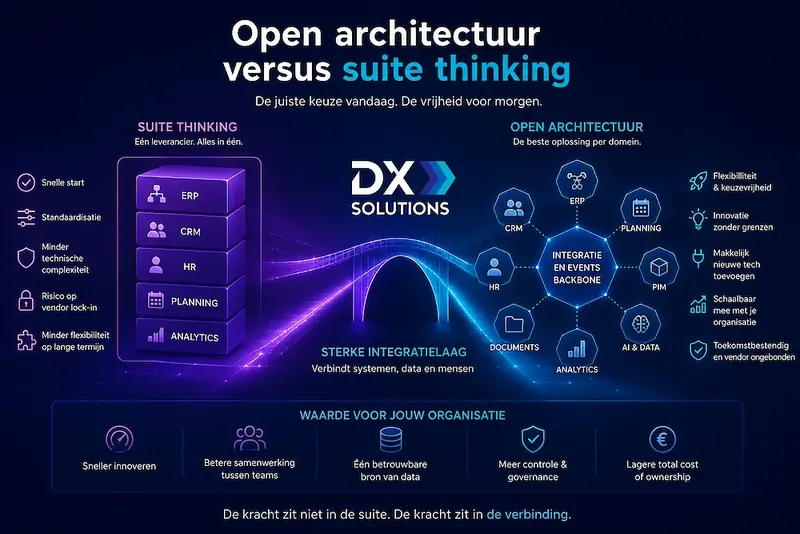
Open architectures create freedom of choice
At DX-Solutions, we strongly believe in open architectures.
Not because open is always better.
Yes, because companies need to be able to respond to change ever more quickly.
That means, among other things:
Keeping data accessible Decouple integrations from individual applications Use standard protocols where possible Do not unnecessarily lock business logic into a single platform Easily integrate new technologies The better these foundations are in place, the easier it becomes to add new features later.
Whether that is a new ERP system, an AI agent, or an entirely new digital strategy.
AI makes this discussion even more important
The rise of AI is accelerating this evolution enormously.
Many organizations are currently experimenting with copilots, agents, and intelligent workflows.
But the companies advancing the fastest are usually not the ones with the most advanced AI tool.
It is the companies that possess:
Accessible data Good integrations Flexible architectures A limited dependence on closed ecosystems Because AI does not derive its value from itself.
AI derives its value from the systems, processes, and data with which it is connected.
Innovation requires freedom of movement
Vendor lock-in is rarely visible on the day of implementation.
The impact is usually only felt when an organization wants to change, expand, or innovate.
Therefore, architecture is becoming increasingly important.
Not as a technical goal in itself, but as a foundation for future choices.
For in a world where technology is evolving faster than ever, innovation is increasingly defined by the freedom to move.
And perhaps that is the most important strategic characteristic of a modern IT landscape today.
Watch the video: our approach in two minutes
Modern businesses need a flexible and scalable IT landscape. Discover how DXS supports this.
Discover our AI agents Previous blog:
Why AI without a strong integration layer often fails Next blog: