Application, Middleware & iPaaS: why companies are losing track
AI, middleware, APIs, and iPaaS are following each other in rapid succession. Discover why companies struggle with modern IT architectures and integrations.
Friday 22 May 2026 · Xavier D.
Automation, Middleware & iPaaS: why companies today can't see the wood for the trees Data Tech Artificial Intelligence
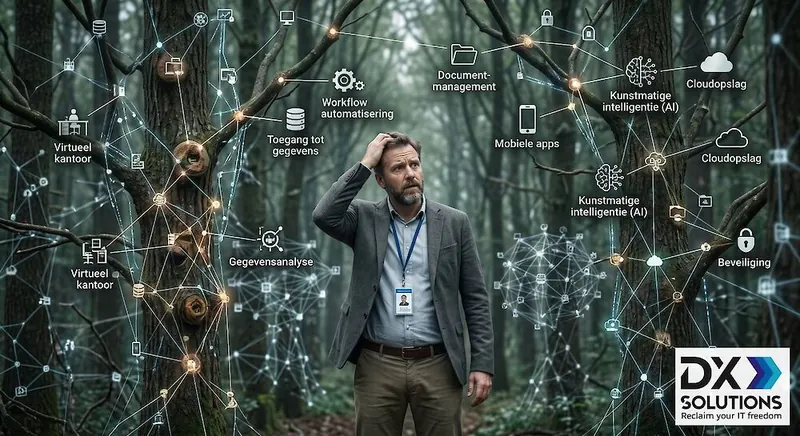
𝐀𝐮𝐭𝐨𝐦𝐚𝐭𝐢𝐨𝐧, 𝐌𝐢𝐝𝐝𝐥𝐞𝐰𝐚𝐫𝐞 & 𝐢𝐏𝐚𝐚𝐒: why companies today can no longer see the wood for the trees
AI. Automation. Middleware. APIs. iPaaS. Event-driven architecture.
Anyone discussing digital transformation today is flooded with new terms, platforms, and technological promises. Every software company claims to be faster, smarter, and more innovative. Every platform promises to be the solution for integration, automation, and AI.
But for many companies, it becomes precisely because of this that it becomes more difficult to see clearly where the real strategic choices lie.
In recent years the IT landscape of organisations has fundamentally changed. Where one ERP system used to be central, companies today work with an ecosystem of cloud platforms, specialised software, mobile applications, AI tools, external data sources and APIs that must continuously communicate with each other.
And that is exactly where the real challenge often arises.
Because digital transformation today is rarely about a single software package. The greatest complexity usually lies in everything in between: how systems work together, how data flows, how flexible processes remain and how quickly an organisation can respond to change.
Many businesses today feel that their landscape is becoming increasingly difficult to manage:
integrations grow organically data is spread across multiple systems processes become fragmented dependencies increase flexibility slowly disappears from the landscape At the same time, the pressure to innovate faster is rising. AI accelerates that evolution even further. Organisations want to experiment with copilots, intelligent workflows, real-time insights and automation, but often run into a fundamental problem: systems do not communicate sufficiently with each other.
And that is precisely why middleware, automation platforms and iPaaS solutions are gaining so much importance today.
Although those terms often sound technical, it is essentially about something very strategic: how do you build an IT landscape that remains flexible enough to enable future change?
That is no longer a purely technical discussion. It directly affects:
scalability innovation capacity speed of implementation operational efficiency vendor lock-in cost control future AI possibilities At DX-Solutions we notice that more and more companies realise that the value of software no longer lies only in the applications themselves, but above all in the way everything is connected to each other.
And that is exactly why we see so many new players appearing on the market today: n8n, Workato, Boomi, Pelqan, Make, Zapier, MuleSoft, Power Automate and many other platforms are each trying in their own way to make that growing complexity manageable.
But at the same time this creates a new problem: companies lose the overview.
Which technology suits which organisation? When do you choose flexibility? When governance? How do you avoid today's solution becoming a limitation again tomorrow? And how do you ensure that AI does not remain a stand-alone experiment, but becomes truly integrated into business operations?
Er bestaat vandaag geen universeel antwoord op die vragen.
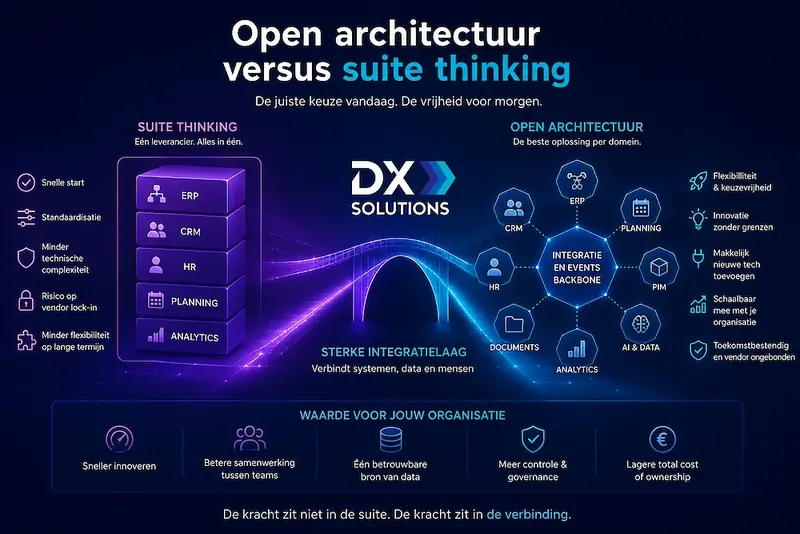
What is becoming clear is that organisations increasingly need open, flexible and scalable architectures that support change instead of slowing it down.
And that is precisely why we at DX-Solutions are starting this blog series.
Not to publish yet another list of buzzwords, but to bring clarity to a market that is becoming ever more complex. From practical experience. From architectural vision. And above all from the conviction that technology should give companies more freedom, not less.
In the following blogs we will go deeper into themes such as middleware, vendor lock-in, event-driven architectures, AI integrations and modern iPaaS platforms. Not from hype, but from the strategic choices companies really face today.
Watch the video: our approach in two minutes
Modern businesses need a flexible and scalable IT landscape. Discover how DXS supports this.
Discover our AI agents Previous blog:
Middleware is the new nervous system of companies Next blog:
Security is no longer an IT detail. AI is changing the rules of the game.
Related article
General
Why modern companies choose middleware and how a data...
Wednesday 19 November 2025, Xavier Ask ten companies what software they use, and you'll get ten completely different landscapes: an ERP here, a CRM there, a planning tool in the cloud, an accounting system that runs locally, a webshop in between and at least one Excel file trying to keep it all together.