Middleware: why it is becoming the new nervous system of companies
Discover why middleware is becoming crucial for modern IT landscapes, AI integrations, and flexible digital growth.
Wednesday 27 May 2026 · Xavier D.
Middleware is the new nervous system of companies Data Artificial Intelligence Tech
Middleware is the new nervous system of companies
Years ago, digital strategy revolved primarily around the choice of software packages. Which ERP do we choose? Which CRM? Which webshop? Which planning tool?
Today, the real challenge lies elsewhere.
For even the best software quickly loses its value when systems do not communicate efficiently with each other. And that is precisely where we see a fundamental shift emerging within modern organizations: middleware is evolving from a “technical interface” into a strategic building block of the entire IT landscape.
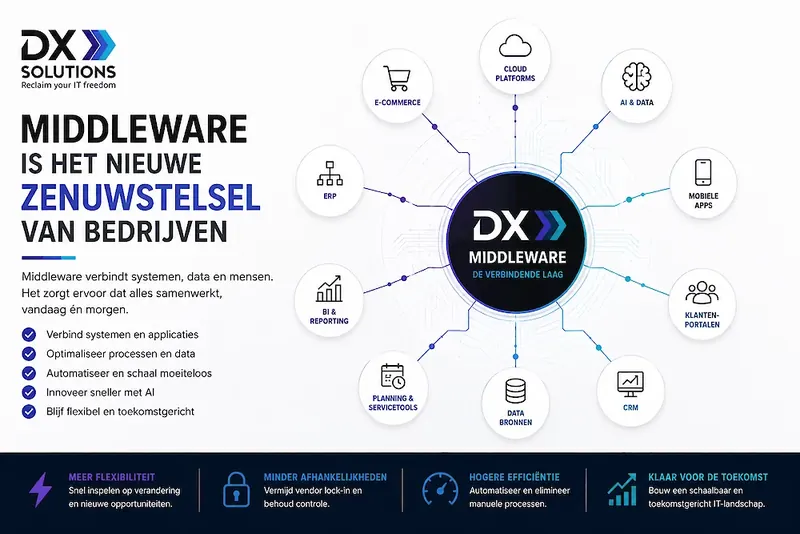
More and more companies today work with a combination of specialised applications:
ERP systems CRM platforms e-commerce mobile apps BI tools AI solutions external data sources SaaS platforms customer portals planning and service tools Each system has its own strengths. But the bigger that landscape becomes, the more important the connections between those systems become.
And that is exactly where the greatest complexity often arises.
Many organisations grow historically. New software is added when a new need arises. An extra tool for planning. A new webshop. An AI solution. An external data source. A customer portal.
Op zich logisch.
But without a clear integration strategy, a landscape gradually emerges in which:
data becomes scattered processes fragment synchronisations become error-prone dependencies increase flexibility disappears innovation slows down At a certain point the IT landscape is no longer an accelerator, but a brake on change.
And that is precisely why middleware is becoming so important today.
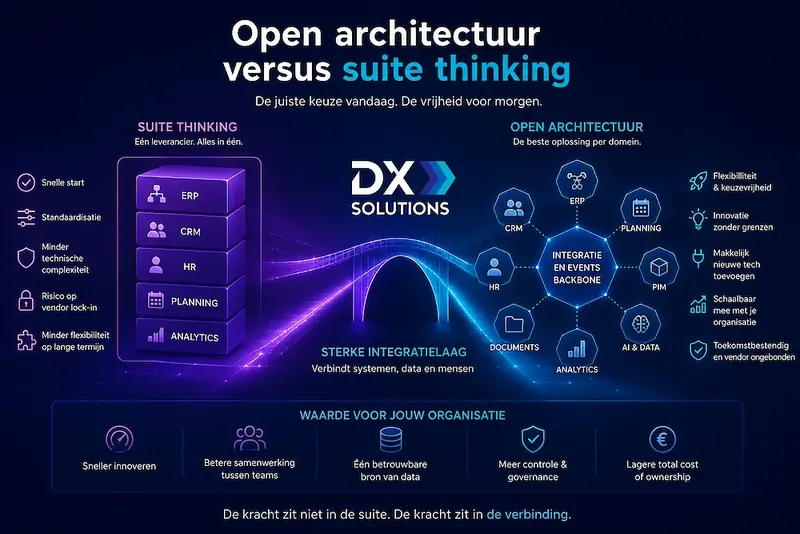
Middleware ensures that systems can communicate with each other in a controlled, scalable and flexible way. Not via loose point-to-point connections, but via a central architecture layer that manages data flows, processes and integrations.
That sounds technical, but its impact is particularly strategic.
Because organisations that organise their integration layer well:
can add new applications faster avoid duplicate data and manual processes integrate AI faster into existing workflows become less dependent on one software vendor can respond to change faster retain more flexibility towards the future And it is precisely that flexibility that is becoming ever more important.
The rise of AI is enormously accelerating that evolution. Many companies today invest in copilots, AI assistants and automation, but quickly run into the same problem: AI is only as strong as the data and systems it has access to.
When information is scattered across islands, the result is not an intelligent organisation, but only intelligent fragmentation.
Daardoor verschuift middleware vandaag steeds meer richting:
realtime orchestration event-driven architectures API management AI integrations workflow automation data streaming In other words, the integration layer becomes the nervous system of the organisation. Not the applications themselves, but the way everything is connected to each other increasingly determines how agile a company really is.
At DX-Solutions we notice that companies are increasingly looking for open and flexible architectures in which technology is not an endpoint, but a foundation for future growth.
And that is precisely why we see middleware evolving today from a technical niche to a strategic core component of modern business operations.
Watch the video: our approach in two minutes
Modern businesses need a flexible and scalable IT landscape. Discover how DXS supports this.
Discover our AI agents Previous blog:
Vendor lock-in: the invisible brake on innovation Next blog:
Automation, Middleware & iPaaS: why companies today can't see the wood for the trees