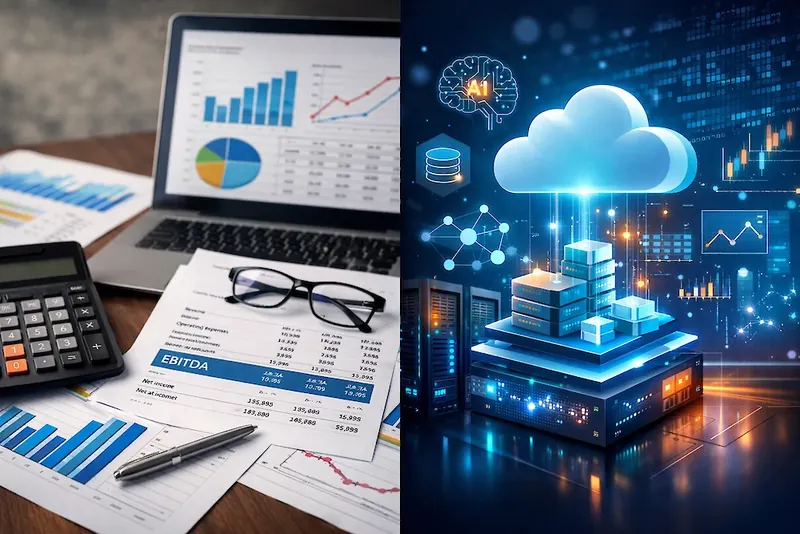
Would you rather buy a company with good numbers... or one with a strong future?
Tech General
Would you rather buy a company with good numbers… or one with a strong future?
Anyone who has ever bought or sold a company knows the drill:
EBITDA, normalized EBITDA, recurring revenue, churn, cash position, backlog.
Key figures. Absolutely.
But in recent years I increasingly see that there is still an elephant in the room:
technical debt .
And you don't see that in the annual accounts.
EBITDA is a snapshot
EBITDA says a lot about today.
Normalized EBITDA attempts to correct for exceptions.
Useful for negotiations.
Necessary for ratings.
But EBITDA doesn't tell you:
how future-proof the company is how scalable the business model is how quickly you can innovate how vulnerable you are if one senior profile fails A good EBITDA with a fragile technical base is sometimes just… deferred misery.
The team remains crucial
Every investor knows:
You don't buy numbers.
You buy people.
A strong team can fix a lot.
But even a strong team will sooner or later encounter limits such as:
knowledge resides in heads, not in systems processes are not documented integrations have grown historically IT emerged “organically” without vision data is fragmented reporting requires manual puzzle work every new idea feels “technically difficult” That's not the team's fault.
That's that has built up as the company grew.
The new question in acquisitions
The real strategic question today is no longer:
“How good were the numbers over the past 3 years?” But also:
“How ready is this company for the next 5 years?” Compare two companies:
Company A Nice EBITDA Good figures, stable for several years But: outdated IT No middleware Point-to-point integrations Data distributed Reporting is manual Vendor lock-in with 1 supplier AI and BI are 'future plans'
Company B Equally good or slightly lower EBITDA But:
clear architecture middleware layer medallion architecture for data scalable integrations data platform BI in order AI-ready foundation conscious choices regarding vendor lock-in and freedom On paper, Company A is often cheaper.
In reality, you pay the difference later – with interest.
Technical debt = hidden acquisition cost
Technical debt translates into:
slow time-to-market high integration costs expensive workarounds frustration in teams greater dependence on external parties limited flexibility with new regulations missed opportunities around data & AI The result?
The “cheap” takeover turns out to be the most expensive.
Acquisitions today are no longer an Excel exercise
Whoever buys companies today, also buys:
architecture data foundation integration capacity flexibility freedom from vendors maturity in BI & AI scalability for growth or consolidation Whether you like it or not:
digital maturity has become a rating factor.
Not always visible in EBITDA.
Visible in the speed at which you can create value after the acquisition.
Freedom vs. vendor lock-in
What we often see:
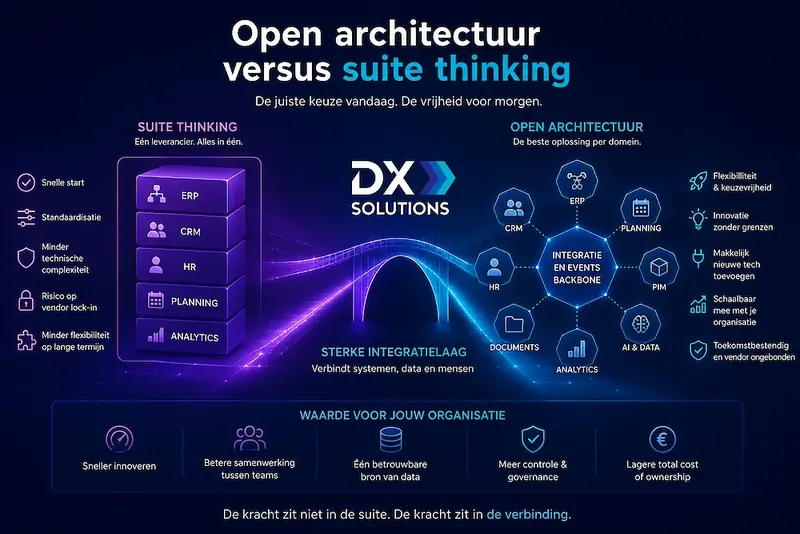
everything is tied to one ERP integrations are proprietary data is locked up expand = buy licenses change = follow vendor That feels comfortable… until you want to grow, integrate, consolidate or innovate.
Digital freedom does not mean “building everything yourself”.
It means:
👉 Make choices that keep you agile.
This is what DX-Solutions stands for
At DX-Solutions we don't start from tools.
We start from freedom:
freedom to integrate freedom to grow freedom to utilize data freedom to apply AI freedom to switch vendors freedom to make acquisitions profitable Middleware, data architecture, medallion models, BI, AI, integrations… Those are not IT projects.
These are strategic investments in the value retention of your company.
So…what would you rather buy?
A company with:
polished numbers nice EBITDA but high technical debt or a company with:
strong foundations proven digital investments lower technical debt more freedom more scalability more future The right buyer today will look at both But those who only look at EBITDA are mainly buying the past.
Whoever looks at technical maturity, buys the future.
Watch the video: our approach in two minutes
Modern businesses need a flexible and scalable IT landscape. Discover how DXS supports this.
Discover our AI agents Previous blog:
Security is no longer an IT detail. AI is changing the rules of the game.