Security is no longer an IT detail. AI is changing the rules of the game.
Anthropic warns of new AI agents that autonomously seek out and exploit software vulnerabilities. Discover why cybersecurity is more important than ever today.
Wednesday 6 May 2026 · Xavier D.
For years, cybersecurity was often viewed as something that “went with it.” A firewall. An audit. A penetration test. A password policy. Important, certainly, but rarely the core of the strategic discussion.
That time is over.
With the advent of AI agents, cybersecurity is shifting from protection against human attackers to protection against systems that can autonomously search, test, combine, and learn.
From human hackers to autonomous AI agents
Anthropic recently released the Claude Mythos Preview .
An AI model that, according to the company itself, is currently too powerful and too risky to launch publicly.
According to Anthropic, the model can:
detect vulnerabilities building exploit chains analyze error messages detect privilege escalation investigating complex software environments In some cases, vulnerabilities were even discovered that remained undetected for years.
Think of a maze
A human hacker tries one lead at a time.
An AI agent works differently.
Think of a maze where you can clone yourself hundreds of times.
Each copy attempts a different corridor at the same time.
After a few seconds, all information comes together again:
which paths work where error messages occur where rights escalate where buffers overflow which combinations grant access That changes everything.
AI makes companies faster.
But AI also makes attackers faster.
Why this is a tipping point
According to reports from Anthropic, AI can already do today:
conduct reconnaissance testing vulnerabilities validate credentials perform lateral movements extract data And that largely autonomously.
Where specialized teams were previously needed, AI today reduces:
the cost the necessary expertise the speed of attacks
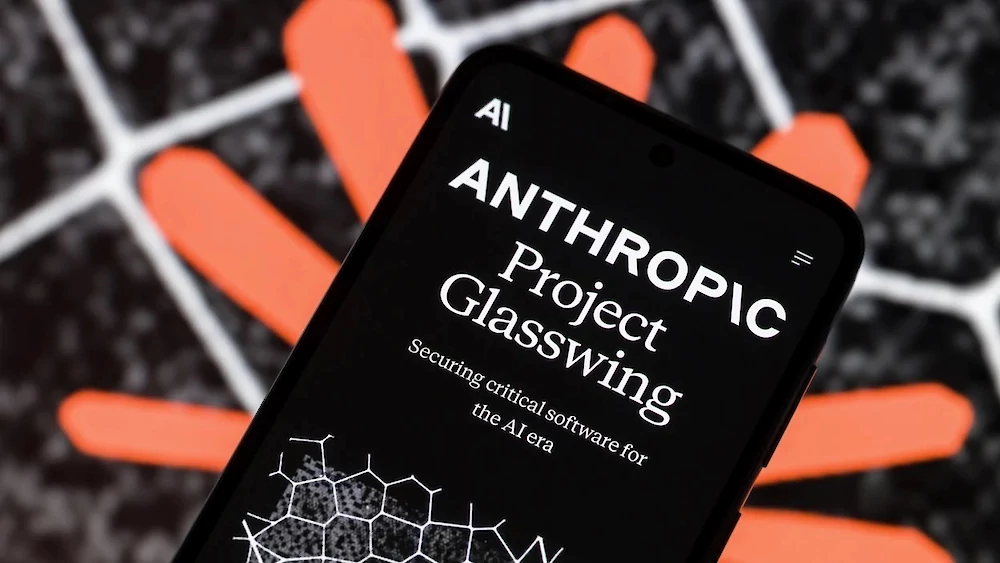
Project Glasswing
That is why Anthropic also launched A controlled program in which a limited number of major technology and security players gain access to Mythos Preview to:
to test systems to detect vulnerabilities faster to build defenses to seal leaks before wider spread Companies such as Amazon, Microsoft, and other major security players are mentioned in this context.
Security must be integrated into the architecture
Security should no longer be a “last resort” today.
Not after development.
Not after going live.
Not after growth.
But from day one.
In:
architecture integrations rights structures API design logging monitoring AI governance data security
The real question
The question is no longer:
Do we need security?
But rather:
Is our organization ready for a world in which vulnerabilities are continuously and mechanically sought out?
At DX-Solutions, we believe that security is not an extra layer on top of software.
It is a fundamental building principle.
AI accelerates businesses.
But AI also accelerates attackers.
And that is precisely why strong, well-thought-out, and future-oriented cybersecurity is becoming more important than ever.