
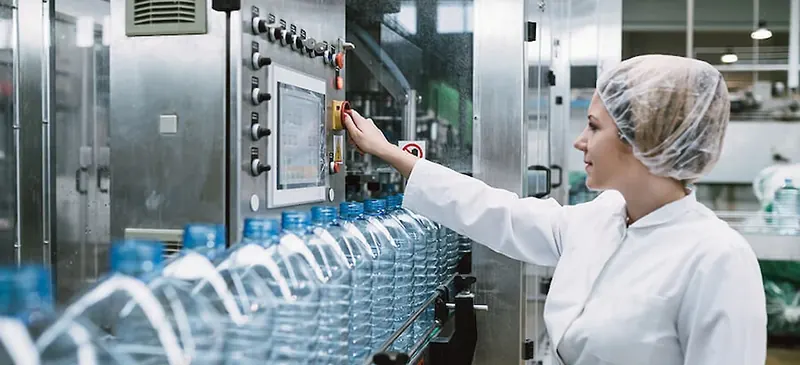
Today's digital production landscape consists of a mix of systems: ERP for planning and administration, CRM for customer management, WMS for warehouse management, PLM for product development. And in between… the MES, the beating heart of production.
Yet it is precisely that heart that often beats the hardest.
The pitfall of the all-in-one system
Many companies try to incorporate their MES directly into their ERP or WMS. It makes sense on paper. Fewer tools, less administration, fewer licences.
But in practice this often leads to the opposite: slow screens, unclear workflows, overloaded interfaces and users who lose their way.
The people on the floor do not need all the tabs of an ERP, they want to see what they have to do, when they have to do it, and how production is doing.
An MES that starts from the user
We believe that a tailor-made tool often performs better here than a standard module.
Not because we necessarily want to develop, but because a custom MES:
adapts to the work floor, not the other way around;
shows only the relevant information for the task or the role;
integrates smoothly with ERP, WMS, CRM and PLM via middleware or iPaaS;
and thereby relieves the other systems instead of burdening them The result: more involvement, fewer errors, faster lead times.
The power of integration
A modern MES does not have to be an island. Via integrations, whether through an iPaaS platform, APIs or middleware, data flows seamlessly between the systems.
Orders from the ERP, bills of materials from the PLM, stock levels from the WMS, customer priorities from the CRM… all in one overview for the operator.
This creates a flexible ecosystem in which each system does what it is good at, and the MES forms the bridge between man and machine.
Conclusie
The future of production does not lie in even more standard modules, but in targeted simplicity An MES built with the user in mind, connected to the rest of the landscape, but free of ballast.
A system that not only shows data, but creates confidence on the floor Previous blog:
Why modern companies choose middleware and how a data lake becomes a smart, optional growth layer Next blog:
Why an LLM Alone Isn't Enough
Want to discuss this further?
Contact usRelated
 Tech
Buying or selling a company? EBITDA vs. technical debt explained
Monday 5 January 2026
 General
Why modern companies choose middleware and how a data lake becomes a smart, optional growth layer
Wednesday 19 November 2025
 General
Why an LLM Alone Isn't Enough: Combine AI, RAG, and Classic ML for Business Impact
Wednesday 1 October 2025